
Last updated November 2, 2026
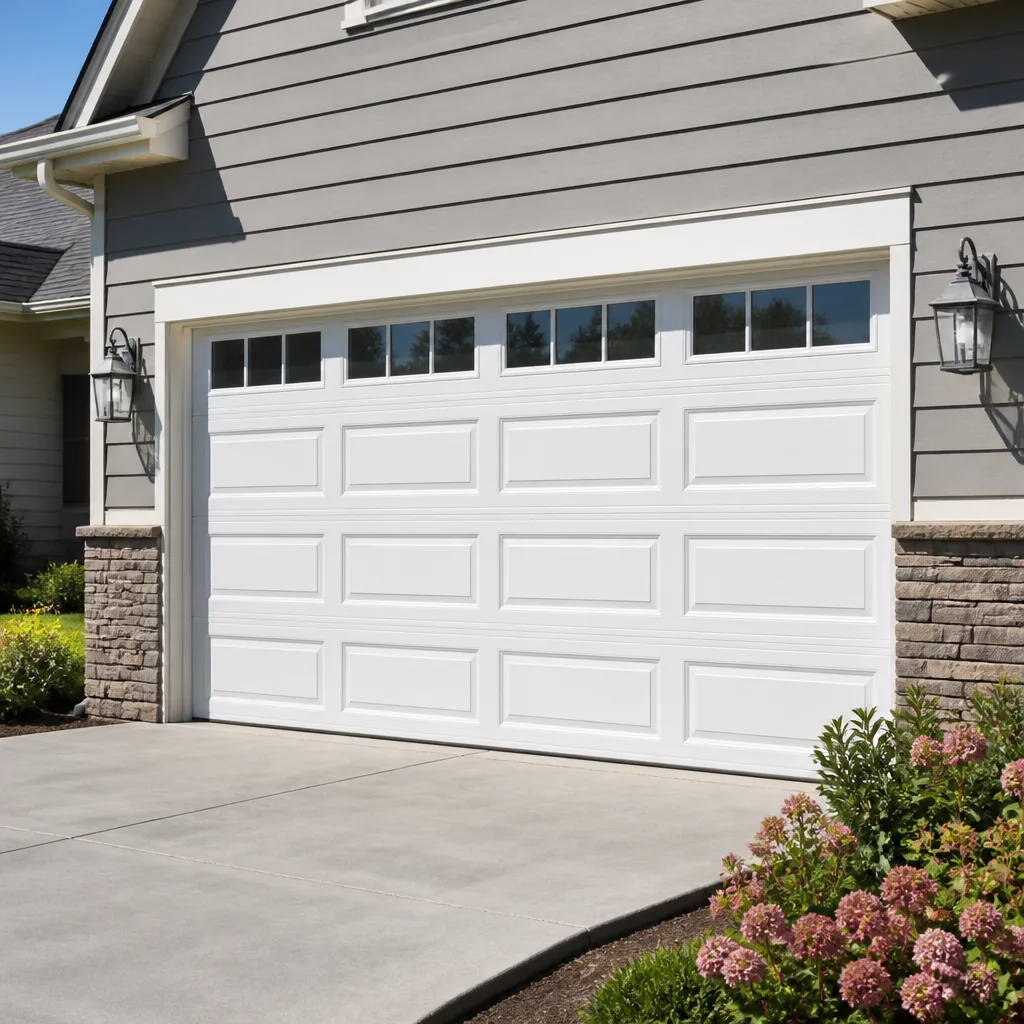 Raised-panel steel
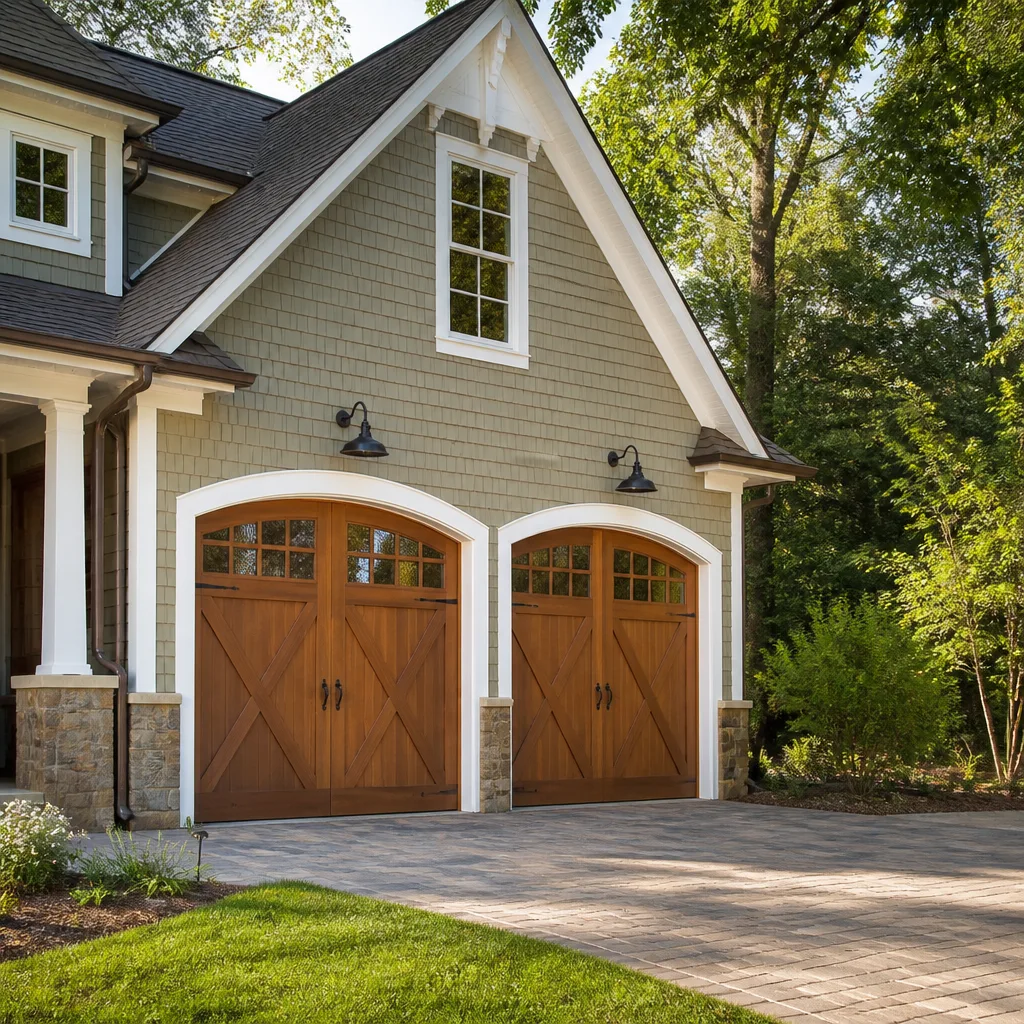 Carriage house
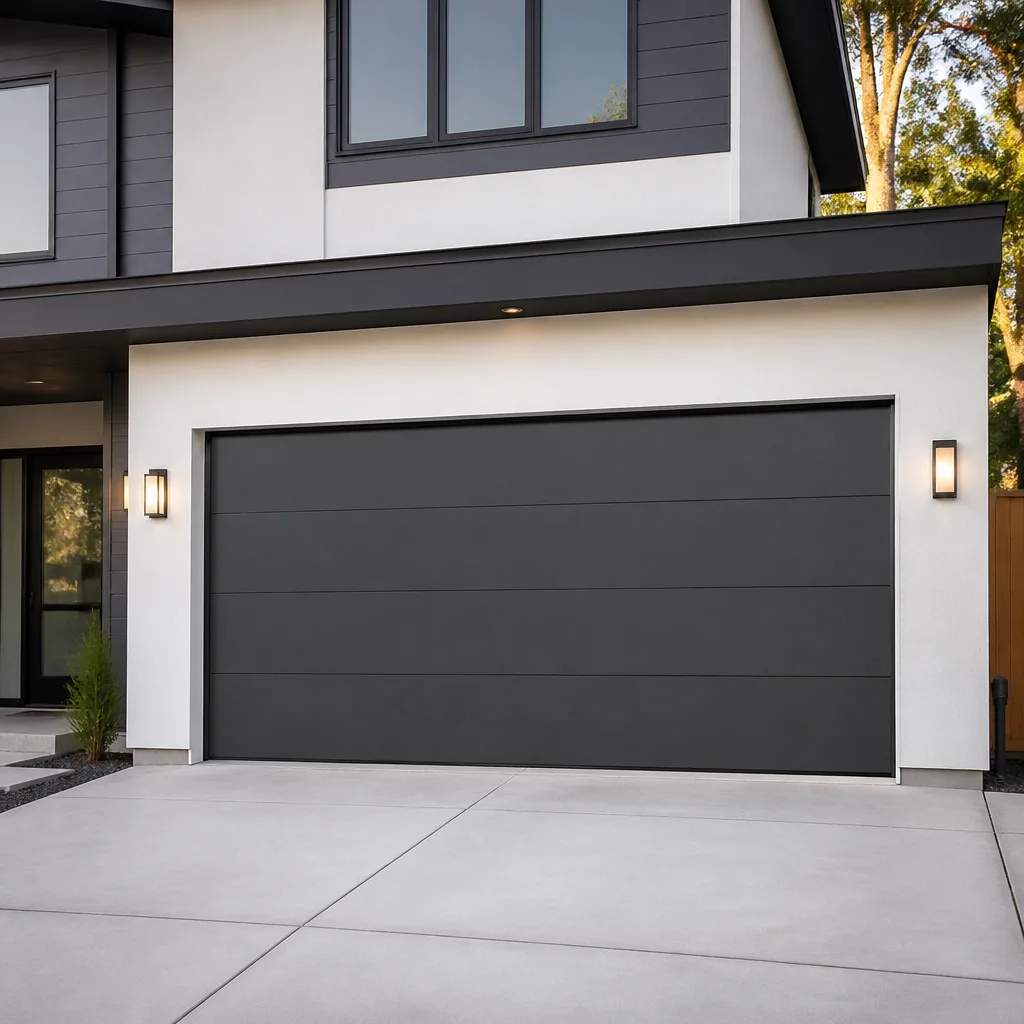 Modern flush
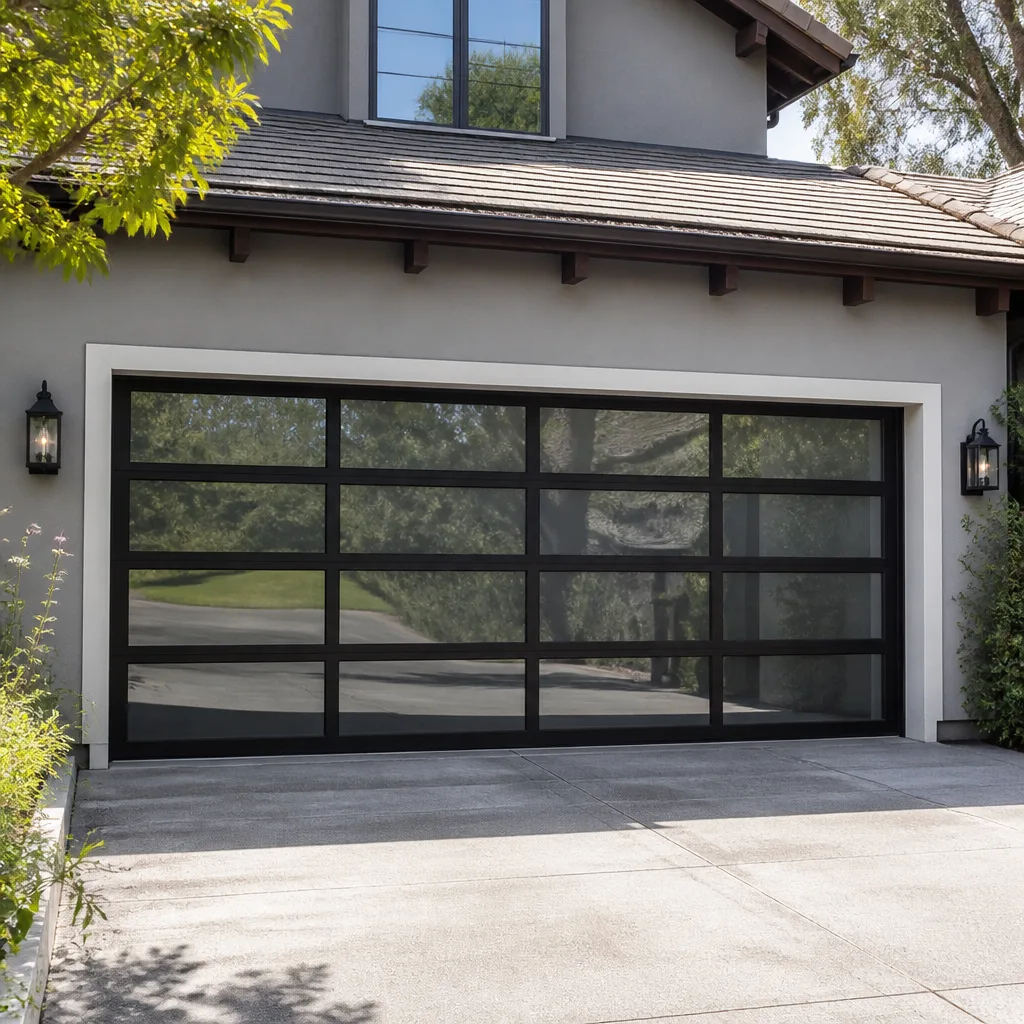 Full-view glass
 LiftMaster openers
 Chamberlain openers
Full 25-point door and opener safety check with every visit - springs, cables, rollers, tracks, and your LiftMaster or Chamberlain opener included
You get a price before we start. It does not change when the truck arrives.
Get your free estimateHow to Hire a Garage Door Contractor in Sunnyvale: A Step-by-Step Guide
Here’s a number that should make any Sunnyvale homeowner pause: roughly four out of ten garage door repair calls in the South Bay end with a contractor recommending full replacement before touching a single bolt. That’s not a diagnosis. It’s a sales script. The garage door trade in this part of Santa Clara County has three very different types of businesses answering the same search queries, and each one has a structural reason to tell you something different. This guide walks you through exactly how to tell them apart, what questions expose the difference, and how to hire the contractor who actually fixes doors in Sunnyvale rather than the one who’s best at selling them.
Quick Answer
To hire a garage door contractor in Sunnyvale, verify their California contractor license (Class C-61/D-28 for garage doors), ask brand-specific diagnostic questions about your door and opener model, get a written quote that itemizes parts and labor separately, and confirm they’ll quote before doing any work. A legitimate repair-first specialist will test the system before recommending anything replacement-related.
Styles & brands we work with
- Raised-panel steel
- Carriage house
- Modern flush
- Full-view glass
- LiftMaster openers
- Chamberlain openers
Table of Contents
- The Three Contractor Archetypes in Sunnyvale
- Why Each Archetype Recommends Something Different
- California Licensing: What It Actually Covers
- The Vetting Questions That Expose Brand Fluency
- How to Read a Garage Door Quote
- When a Second Opinion Is Worth the Trip Fee
- Sunnyvale-Specific Considerations
- Common Mistakes to Avoid
The Three Contractor Archetypes in Sunnyvale
Before you call anyone, understand who actually answers the phone. In Sunnyvale’s garage door market, three business models compete for the same job, and they behave very differently once they arrive at your house.
1. The Repair-First Specialist. This contractor makes money by diagnosing and fixing what’s broken. They stock parts for multiple brands. They carry torsion springs, extension springs, cables, rollers, sensors, and circuit boards on the truck, because they know a service call means fixing the thing during the visit, not scheduling a follow-up. Their incentive is simple: fix it right, charge for the repair, move to the next call. Replacement only comes up when the numbers genuinely don’t work, like a door with a cracked panel, rusted track, and a 20-year-old opener all failing at once. In our experience, this model is the only one aligned with what a Sunnyvale homeowner actually wants when the door won’t open at 7 a.m.
2. The General Handyman With a Garage Door Upsell. This is someone who does many trades: plumbing one day, drywall the next, and garage doors when that’s the call that came in. They understand the basic mechanics but they don’t carry dedicated garage door parts inventory. When a torsion spring snaps, they measure it, order it, and come back in three days. That’s not a knock on their competence, it’s a structural limitation of their business model. Garage doors are one trade among a dozen for them. For you, it means longer timelines and a higher chance of a generic part rather than the correct spring for your specific door weight and cycle rating.
3. The Replacement Sales Team Disguised as a Repair Service. This operator has a fundamental conflict of interest baked into the business model. Their technicians are often paid commission on replacement sales, not on repairs. They answer the same “garage door repair Sunnyvale” search you type in, but their service call is really a sales appointment. The tell: within minutes of arrival, before testing the balance of the door, before checking spring tension, before looking at the opener’s diagnostic lights, they’re talking about “upgrading” or “modernizing” your whole system. They don’t carry parts to fix anything because their trucks aren’t organized for repair. They’re organized for the pitch.
Knowing which archetype you’re dealing with is the single most important part of hiring a garage door contractor in Sunnyvale. The rest of this guide gives you the specific tools to identify each one before you write a check.
Why Each Archetype Recommends Something Different
The contractor types above aren’t just different in style. They have different structural incentives, and those incentives drive their recommendations more than the actual condition of your door. Understanding this is how you protect yourself from overpaying.
Repair-first specialists earn their revenue through diagnostic accuracy and repair completion. A door that’s fixed means an invoice that’s paid. A door that’s misdiagnosed means a callback, a refund, or a bad review, all of which eat into profit. So their recommendation is always the minimal repair that restores function. If a Garage Door Repair in Sunnyvale specialist tells you to replace the door, it’s because the math of repair genuinely doesn’t work: a snapped top panel on a 15-year-old Clopay with rusted hinges and a failing opener, where the repair quote would approach 60% of replacement cost with no warranty on the rest of the system. That’s an honest replacement recommendation.
General handymen recommend whatever gets them out of the job fastest. If the problem looks complex, they’ll tell you to replace because it’s a cleaner transaction: one big ticket, one delivery, one installation, done. They don’t benefit from the long-term relationship of keeping your existing door running. And they rarely have the brand-specific diagnostic tools to determine whether your Genie opener needs a $40 logic board or a $400 replacement. The recommendation to replace is often a shortcut around a diagnosis they’re not equipped to make.
Replacement sales teams have the most straightforward incentive of all. Their compensation, their quota, their very job security depend on selling doors and openers, not repairing them. That’s why they quote replacement so quickly. The 90-second replacement pitch isn’t a sign of expertise. It’s a sign that the person in your driveway has no financial stake in fixing your problem, only in replacing your equipment. We’ve had Sunnyvale customers hand us quotes from commission-based companies for full door-and-opener replacements where the actual issue was a snapped cable and a misaligned sensor, a $300 repair on a door with 10 years of life left in it.
The lesson: whenever a contractor recommends replacement, ask yourself which of these three business models would benefit from that recommendation. Then ask the questions in the next section.
California Licensing: What It Actually Covers
California’s contractor licensing system is specific, and it matters in Sunnyvale because the local market has a healthy population of unlicensed operators working the trade. Here’s what a legitimate garage door contractor carries and what it means for you.
In California, garage door installation and repair falls under the Contractors State License Board (CSLB) classification C-61/D-28, Door and Gate. This is a limited specialty classification that specifically covers the installation, repair, and modification of garage doors and their components: springs, cables, track, panels, rollers, hinges, and motorized openers. Any contractor performing garage door work in Sunnyvale for labor and materials exceeding $500 total (including parts and labor combined) must hold this license or a general building contractor license (Class B) that permits the work.
Here’s the practical checklist:
- Check the license number. Ask for their CSLB license number, then verify it at cslb.ca.gov. The state maintains a public database that shows the license status, classification, bond, and any disciplinary history. A contractor who hesitates to give you this number has already told you everything you need to know.
- Confirm the D-28 classification. The license number itself isn’t enough. A plumber with a C-36 license doesn’t have the legal authority to install or repair your garage door. Look for D-28 specifically, or a Class B with garage door work listed in the scope. We’ve seen Sunnyvale homeowners hire general contractors with C-10 electrical licenses who did unpermitted opener wiring, creating a code violation that surfaced later during a home sale inspection.
- Check the bond. Every active CSLB license carries a contractor’s bond of at least $25,000. This bond protects you if the contractor causes damage and fails to fix it. The CSLB database will show whether the bond is active.
- Ask about workers’ compensation insurance. If the contractor has employees, California requires workers’ comp coverage. If they’re a solo operator, they can sign a waiver. Either way, you should see documentation. A contractor without workers’ comp who gets injured on your property can name you in a claim against your homeowner’s insurance.
- Understand what’s legal without a license. In California, work under $500 total (including parts and labor) can technically be performed without a contractor’s license. Practically speaking, almost no meaningful garage door repair in Sunnyvale falls under that threshold anymore. A torsion spring replacement with parts and labor typically runs $180 to $340. A cable replacement is $150 to $250. An opener swap is $300 to $600. Most jobs exceed $500 quickly, which means the unlicensed handyman down the street is operating illegally on almost every call.
The licensing question is the first filter. If a Sunnyvale contractor can’t produce a valid D-28 license instantly, end the conversation right there. Everything else about your door becomes irrelevant if the person working on it isn’t legally permitted to be there.
The Vetting Questions That Expose Brand Fluency
This is where the legitimate specialists separate from everyone else. A garage door is not generic. A Clopay steel door from the early 2000s has different spring requirements than a 2023 Amarr Energy Series door. A Wayne Dalton TorqueMaster system uses completely different spring hardware than a standard torsion setup. A Craftsman opener from 2008 has a different logic board failure pattern than a 2021 Chamberlain with a DC motor. None of these are interchangeable.
So before you schedule, ask these questions, ideally on the phone or by text where their answer comes without time to Google it:
1. “What brand is my door and opener?”
This isn’t a question for them to answer sight unseen. It’s a question to see if they ask you before diagnosing. A multi-brand specialist will ask: What brand is the door? The opener? How old? Belt drive or chain? Wall mount or overhead? A replacement salesperson will skip all of it and start talking about what they have in stock. A general handyman will say “I’ll take a look when I get there” without asking anything, which is honest but also an admission that they don’t carry brand-specific diagnostics or parts.
2. “Do you carry parts for [your brand] on the truck?”
A specialist running a genuine garage door repair service in Sunnyvale carries torsion springs in multiple sizes, extension springs, cables, rollers, hinges, sensors, remotes, and common opener parts. We stock parts that fit Clopay, Amarr, Wayne Dalton, and Raynor doors, and opener components for LiftMaster, Chamberlain, Genie, and Craftsman systems. If the answer is “we’ll order what we need and come back,” that’s a handyman, not a garage door contractor. You’re paying for two trips and waiting days for a fix that should take one visit.
3. “How do you diagnose a spring issue vs. an opener issue?”
The correct answer involves checking the door balance manually first (disengaging the opener and lifting the door by hand to see whether it holds at mid-height), then reading the opener’s diagnostic codes. A sales rep will answer with a question about how old the door is. A handyman will say something vague about “checking to see what’s wrong.” A specialist answers with a process, because a real diagnosis is a process, not a guess. The fact that we work on what you already have means we’re looking for the failure point, not a reason to replace.
4. “What are the common failure points on a [your brand] door?”
Try this: “What are the common failure points on a Clopay door like mine?” A contractor who can’t answer with specifics, like the hinge-to-panel attachment points on older Clopay models or the bottom bracket fatigue on heavy wooden doors, doesn’t actually know that brand. They know the marketing language around it. Your garage door opener repair in Sunnyvale follows the same logic for LiftMaster, Chamberlain, Genie, and Craftsman systems. Brand fluency is specific or it isn’t real.
5. “Will the same technician who diagnoses the problem be the one fixing it?”
This question catches the sales-appointment model. Many replacement companies send a “comfort advisor” or “project consultant” to quote the job, then schedule a separate crew for the install. That’s two different people, two different incentives, and your diagnostic information gets filtered through a handoff. A specialist sends a technician who carries tools and parts, diagnoses on site, and fixes the problem during the same visit. One call covers the door and the opener, not a phone tree and a rescheduled appointment.
How to Read a Garage Door Quote
Most homeowners in Sunnyvale don’t know how to read a garage door quote because they’ve never had to. Here’s what a legitimate repair quote looks like, and what the red flags are before any work starts.
A legitimate quote has these five characteristics:
- Itemized parts and labor. It says “Torsion spring, 0.250 x 2″ x 28″, oil-tempered, 30,000-cycle rating: $X. Labor: $Y.” It does not say “Spring repair: $X” with no breakdown. If the quote won’t separate what you’re paying for the part versus what you’re paying for the technician’s time and expertise, you can’t evaluate whether the part or the labor is the right price.
- Specific part numbers or specifications. For a Clopay door, the quote should reference a spring size that matches the door’s weight and height, not “standard spring.” For an Amarr door, the quote should specify the hinge size and panel type if panels are being replaced. Generic line items (“door component – various”) tell you the contractor is deciding what to use when they see it, which means they don’t know the door yet.
- A total that’s fixed before any work starts. The price quoted and agreed to is the price you pay, period. Any contractor in Sunnyvale who says “we’ll see how it goes and let you know” is asking you to sign a blank check. Legitimate specialists quote firmly because they’ve diagnosed the problem correctly and they know what the fix costs. The fear that the invoice will be bigger than the quote is exactly why this matters so much on garage door work specifically.
- Warranty terms in writing. What’s the warranty on the part? What’s the warranty on the labor? A typical spring replacement carries a 1-3 year part warranty depending on the spring rating. Opener repairs often carry a 90-day labor warranty with a 1-year or longer part warranty. If the quote doesn’t specify warranty terms, assume there aren’t any.
- A diagnostic conclusion, not a sales presentation. The quote should state the diagnosis (“broken torsion spring, right side, fatigue at the cone”), not a lifestyle pitch (“your door is older and you might want to consider upgrading”). A straight diagnosis with clear options and no upsell pressure is what you’re paying for.
Quote red flags that signal a bait-and-switch:
- Missing line items. A quote that says “door service” without specifying spring, cable, track, opener, or panel tells you nothing about what’s being done. That’s room to do less than you paid for.
- Parts priced at 3-4x retail. Markup is normal. Grocery stores mark up milk. But a torsion spring that retails for $35 being charged at $180 is not a markup, it’s a subsidy for a business model that doesn’t actually make money on repairs.
- Labor bundled into everything. When every line item has its own labor charge and you’re paying “labor” for the door, “labor” for the opener, and “labor” for the service call, you’re paying for the same hour three times.
- No model number on opener repair. If the quote says “opener repair” without referencing your specific LiftMaster, Chamberlain, Genie, or Craftsman model number, the contractor hasn’t diagnosed anything. They’re guessing. A guess is fine from a friend. It’s not fine from someone billing you $200.
- A quote that expires in 24 hours with pressure language. “This price applies only if you sign today.” That’s not a quote, it’s a closing tactic. Legitimate garage door work in Sunnyvale doesn’t have flash-sale pricing.
The single most important line on any garage door quote: the price is quoted and agreed before any work starts. If that line isn’t there in writing, add it or walk away.
When a Second Opinion Is Worth the Trip Fee
A second opinion costs money. In Sunnyvale, a diagnostic visit from a licensed garage door contractor typically runs $49 to $99, often credited toward the repair if you hire them. So the question is: when is that second trip fee worth it, and when is the first diagnosis almost certainly correct?
When a second opinion is worth it:
- The first quote is a full replacement recommendation for a door under 12 years old. Unless the door has visible structural damage, a 10-year-old Clopay or Amarr door should not need replacement. Get a second look. We’ve diagnosed doors in Sunnyvale that were quoted for replacement by sales teams and fixed them with a $150 cable and a $40 roller set.
- The quoted repair exceeds $800 and you don’t understand the terminology. At that price point, you’re entitled to certainty. A specialist’s second diagnosis will either confirm the first one (and you can proceed with confidence) or find something the first contractor missed.
- The quote lumps multiple repairs together without explaining each one. “Springs, rollers, cables, and track alignment: $1,100” is not a diagnosis. It’s a menu. A second opinion that itemizes what’s actually broken will usually come in lower and more specific.
- The first contractor can’t answer the brand-fluency questions from this guide. If they don’t know the failure points on a Wayne Dalton door, their replacement recommendation isn’t based on expertise. It’s based on their inventory.
When the first diagnosis is probably correct and a second opinion is a waste of time:
- The door has a snapped torsion spring. This is not a subtle diagnosis. The spring is in two pieces. You can see it. Any competent contractor will tell you the same thing: replace the spring, and while it’s apart, check the cables and rollers. The price range in Sunnyvale for this repair is well established at $180 to $340 depending on spring size and cycle rating.
- The opener motor runs but the door doesn’t move. That’s a stripped gear or a disconnected drive. It’s a specific fix, not a mystery. A second opinion on this one is paying someone to tell you what you already heard.
- The door is visibly off-track. The track is bent or the door has jumped the rollers. You can see the problem with your own eyes. The repair is straightfor a specialist, and a second opinion will confirm what’s already obvious.
- The quote is itemized, specific, and references your actual brand and model. If the contractor said “Your Chamberlain B550 has a failed travel module, part number 41A7269” and the quote shows that part at a reasonable markup, you’ve got a competent diagnosis. Getting a third party to verify something that specific is unnecessary.
A second opinion is a diagnostic tool, not a ritual. Use it when the first diagnosis doesn’t align with the age and condition of your equipment, or when the recommendation is replacement on a door that seems repairable. A repair-first philosophy means that replacement is the last option, not the first one.
Sunnyvale-Specific Considerations
Sunnyvale’s climate and housing stock create specific garage door failure patterns that a contractor should know before they arrive. Here’s what’s different about this city’s doors.
Marine layer humidity and metal fatigue. Sunnyvale sits close enough to the Bay that morning marine layer moisture is a regular feature. Over years, that moisture works on unprotected steel components: torsion springs at the cone attachment points, bottom brackets, cable anchors, and hinge pins. South-facing doors in Sunnyvale get the added stress of afternoon sun heating one side of the door while the other side stays cool, which creates metal fatigue patterns we see consistently. A contractor who knows Sunnyvale expects rust at the spring cones on doors over 8 years old in the southern neighborhoods near El Camino Real, and knows to check it even when the spring hasn’t snapped yet.
Older housing stock with original equipment. A significant portion of Sunnyvale’s single-family homes were built between the 1950s and the 1980s. Many of those garages still have their original doors or doors installed in the 1990s. That means Wayne Dalton and early Clopay installations with hardware that’s no longer produced. A specialist knows how to cross-reference legacy part numbers. A replacement salesperson sees an opportunity to sell a whole new door where a $60 hinge and a lubrication service would have kept the existing one running for another five years.
HOA considerations in planned communities. Sunnyvale has numerous planned developments with HOAs that regulate exterior appearance, including garage doors. If you live in one of these communities, a full door replacement may require HOA approval, which adds time to the project. A contractor who’s worked in Sunnyvale knows to ask about HOA status before quoting a replacement. One who doesn’t know the area won’t think to ask, and you’ll discover the approval requirement after you’ve signed a contract.
Multi-level homes with attached garages. Unlike some parts of the country where garages are detached, most Sunnyvale homes have attached garages with living space above. This matters because door opener noise and vibration travels directly into bedrooms and living spaces. When a specialist recommends a belt-drive replacement over a chain-drive for a specific Sunnyvale home, that’s not an upsell. It’s a recommendation based on the house’s floorplan. A handyman quoting the cheapest chain-drive opener isn’t considering that your kids sleep above the garage.
Heat and opener electronics. Sunnyvale’s 85-95 degree summer days put real stress on garage door opener electronics. The logic boards in older LiftMaster and Genie openers fail more frequently in warm climates because the heat accelerates capacitor aging. If your opener is over 10 years old and the door stops responding intermittently on hot afternoons, that’s a known failure pattern we see consistently in Sunnyvale, not a random glitch.
For a full overview of what garage door repair in Sunnyvale involves, including the specific services a repair-first shop should offer, see our dedicated service page.
Common Mistakes to Avoid
- Hiring the first contractor who answers the search query. The search result rankings in Sunnyvale don’t differentiate between a repair-first specialist and a replacement sales team with a big ad budget. Vet the company, not the ad.
- Accepting a replacement recommendation on a door under 15 years old without a second opinion. Most residential garage doors are rated for 20-30 years. A 12-year-old Clopay door being recommended for replacement should trigger a second look.
- Not checking the CSLB license before scheduling. Five minutes on cslb.ca.gov is the difference between a licensed contractor with a bond and an unlicensed operator who disappears when something goes wrong. The D-28 classification is not optional for garage door work in Sunnyvale.
- Paying more than $500 total without a written contract. California law requires a written contract for any home improvement project over $500. If the contractor wants to do the work on a handshake, they’re not following the law, and you have no documentation if the work fails.
- Choosing a contractor based on the lowest price. A quote that’s 40% below the market rate in Sunnyvale means the contractor is either cutting corners on parts (using unrated springs, for example), operating without insurance, or planning to find additional problems once the door is apart. No legitimate garage door contractor prices 40% below everyone else.
- Ignoring the opener when the door needs work. The door and the drive system work as one integrated unit. If the door is out of balance and the opener is fighting it, you can fix the door and burn out the opener motor in six months. A specialist addresses both. This is the “one call covers the door and the opener” principle in action.
- Skipping the brand fluency test. Asking “Do you know Clopay doors?” and accepting “Yes, we work on all brands” as an answer isn’t vetting. That’s a brand-agnostic script line. Push for specifics: failure patterns, part compatibility, model-specific knowledge.
See the difference
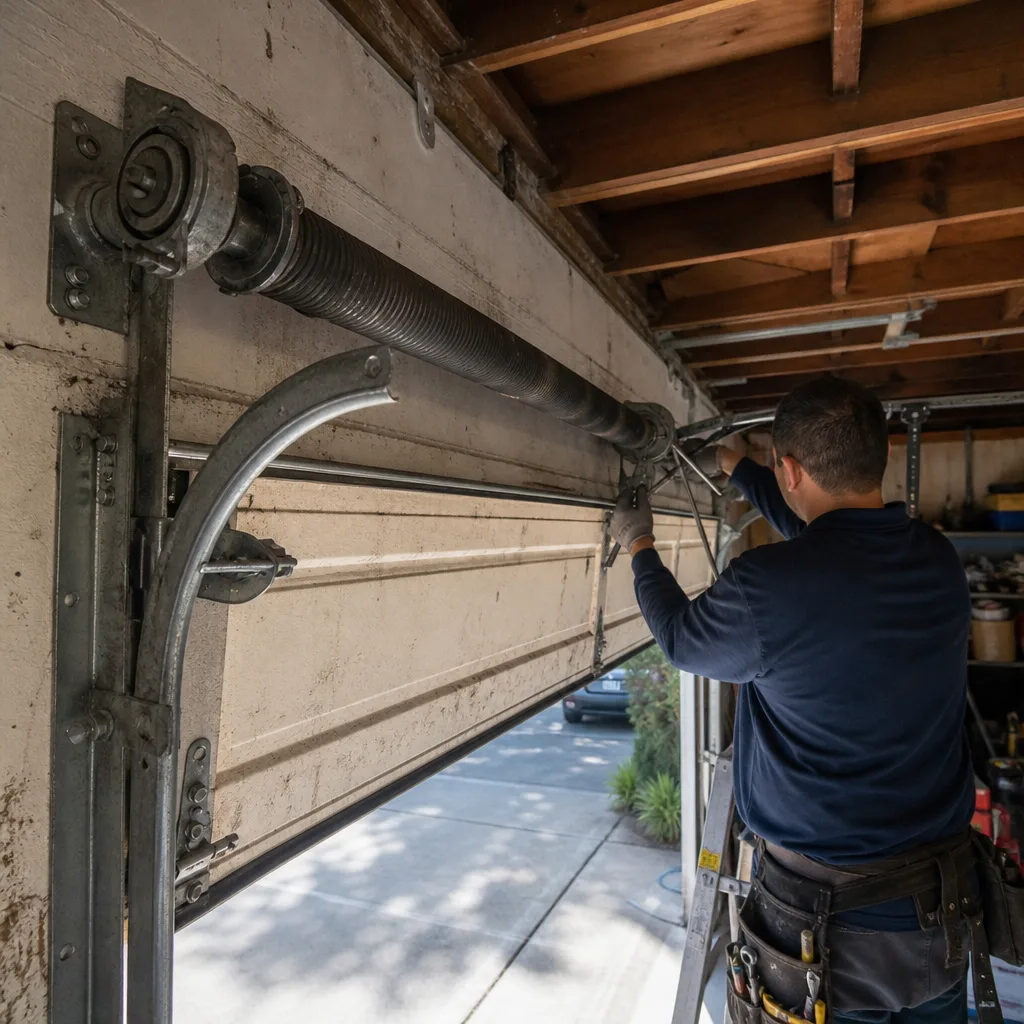 Before
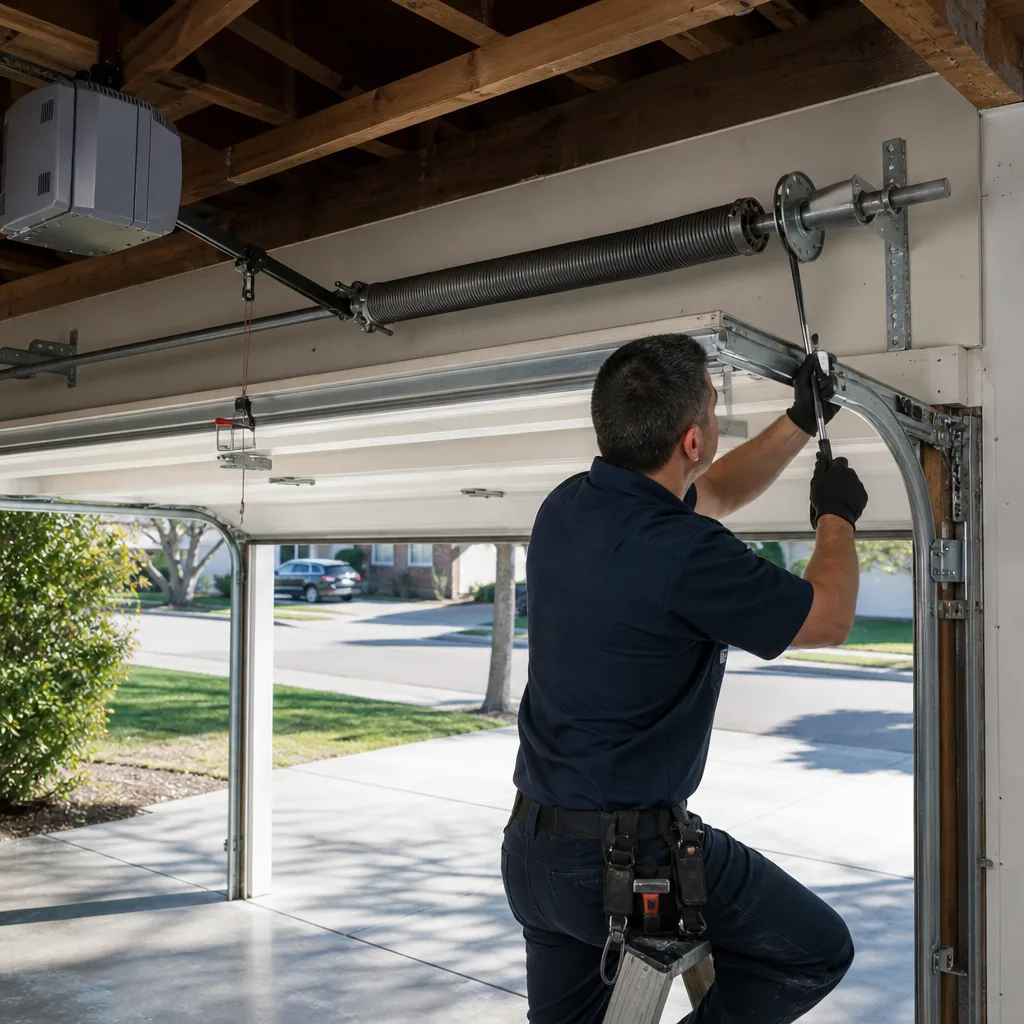 After
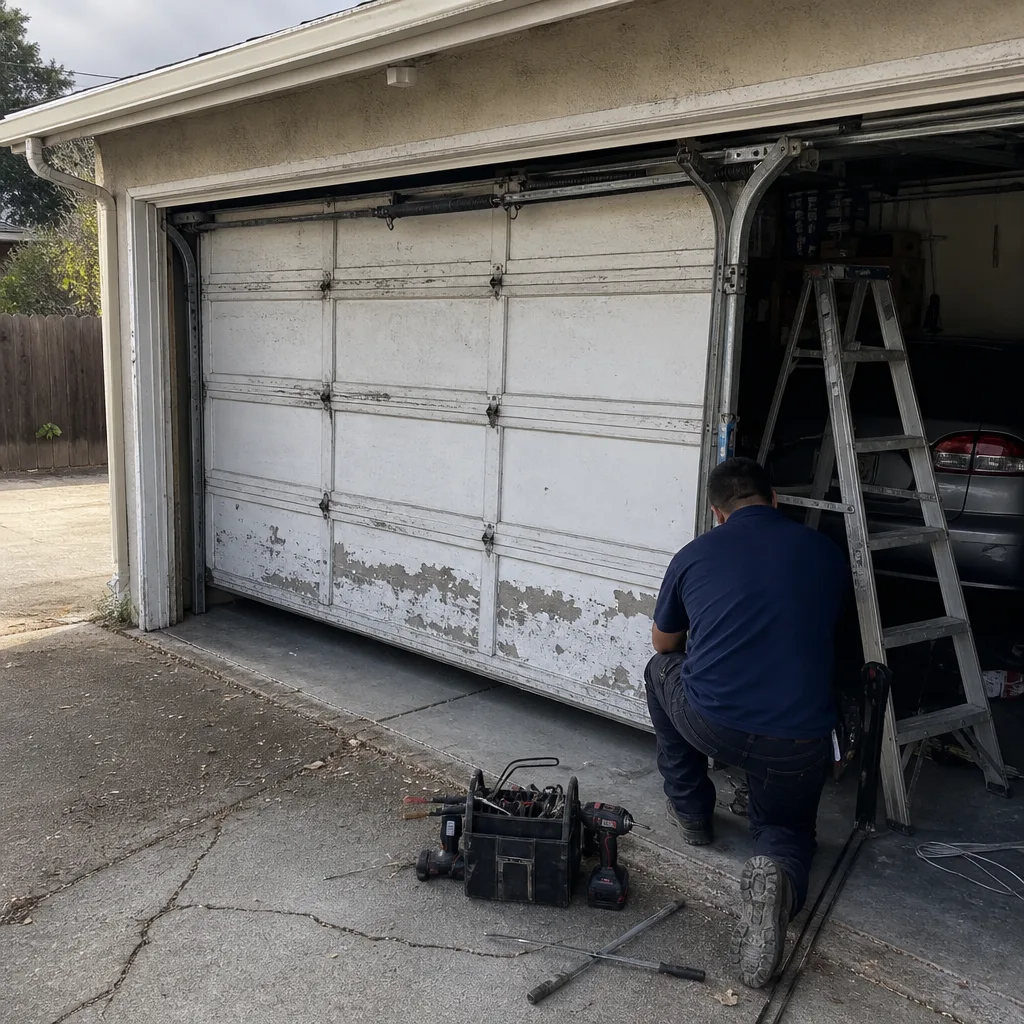 Before
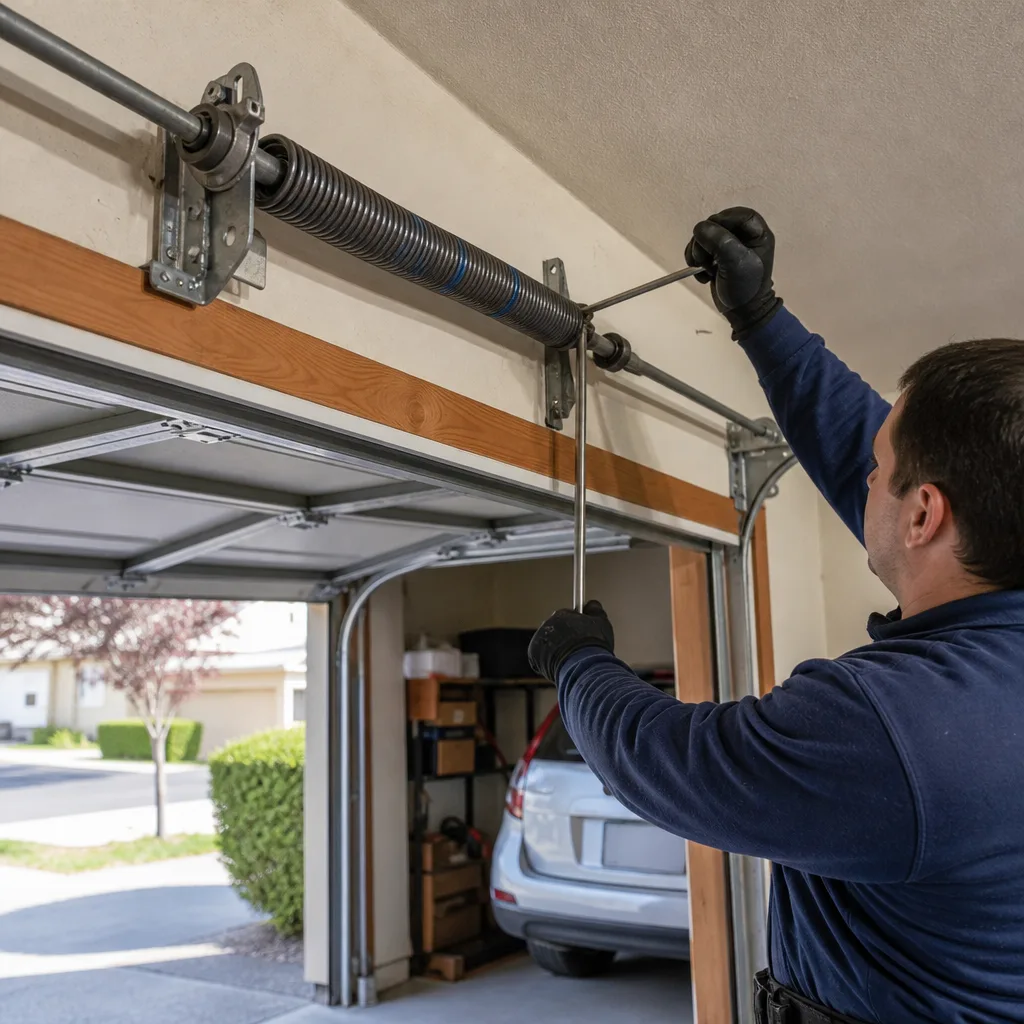 After
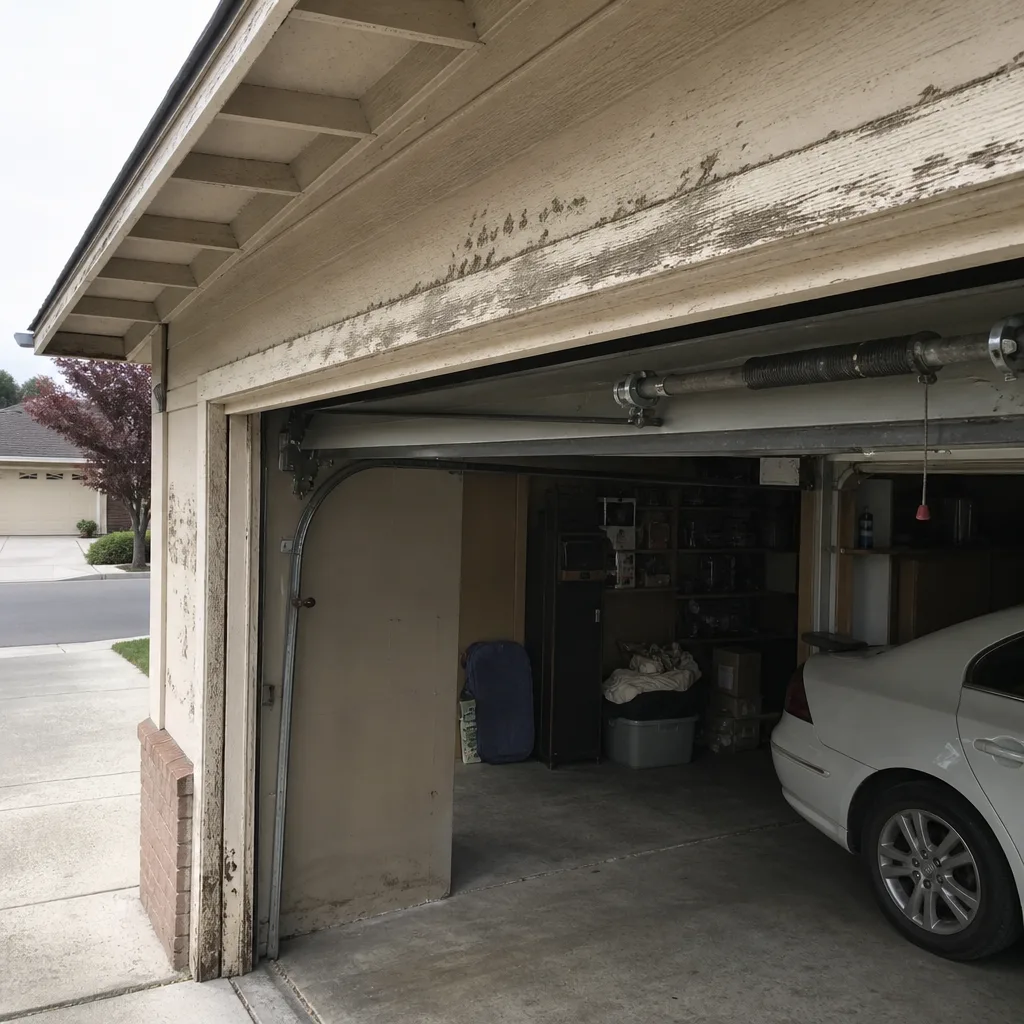 Before
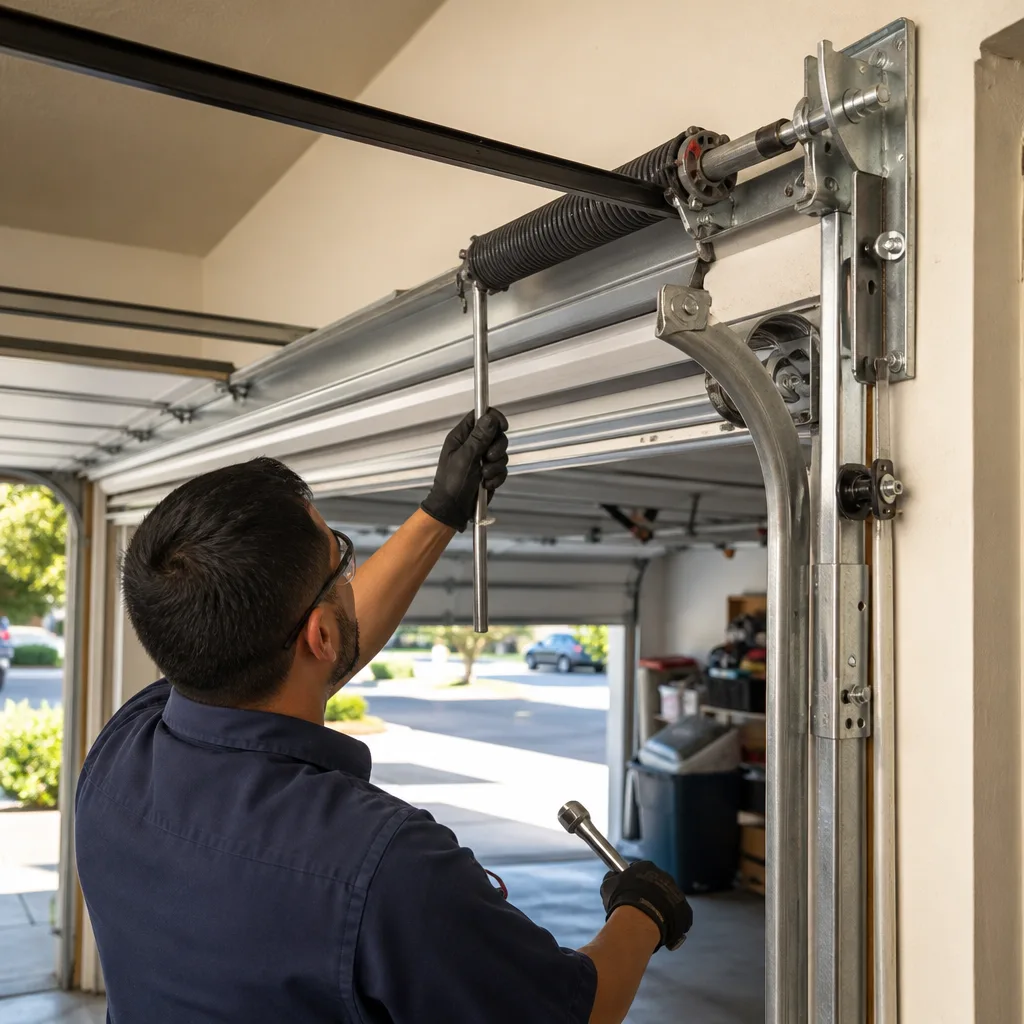 After
When to Call a Professional
Some garage door problems are obvious and safe to identify on your own, but almost none of them are safe to fix without training. A snapped torsion spring stores thousands of pounds of tension and can cause serious injury or death if improperly handled. A door off its track can fall without warning. Opener wiring involves 120V household current. Any of these conditions means the next call should be to a licensed D-28 contractor, not to a YouTube tutorial. If the door won’t open, won’t close, is making unusual noise, or shows visible damage to springs, cables, or track, stop using the door and call a professional.
Commodore Garage Door Repair offers free estimates in Sunnyvale. Call (877) 358-3130.
Frequently Asked Questions
Most garage door repairs in Sunnyvale run $150 to $450 for common fixes like spring replacement, cable replacement, track realignment, and sensor repair. A torsion spring replacement typically costs $180 to $340, a cable replacement $150 to $250, and an opener repair $150 to $400 depending on the component. The exact quote depends on the door brand, spring size, and opener model, which is why a written itemized estimate before work starts is non-negotiable. Call (877) 358-3130 for an exact quote, estimates are free.
You verify their CSLB license number at cslb.ca.gov, where the state database shows the license status, classification (they should hold C-61/D-28 specifically for garage doors), bond status, and any disciplinary history. A licensed contractor will provide this number immediately when asked.
Yes, a repair-first specialist who stocks parts on the truck can diagnose and complete most common repairs, including spring replacement, cable replacement, and sensor repair, during the same visit. This is one of the reasons the brand fluency questions in this guide matter: a contractor who knows your Clopay or Amarr door model has the parts to fix it today, not next week. Call (877) 358-3130 to confirm same-day availability.
We service doors from Clopay, Amarr, Wayne Dalton, and Raynor, and openers from LiftMaster, Chamberlain, Genie, and Craftsman. That means we diagnose and fix what you already own rather than defaulting to replacement. A Wayne Dalton TorqueMaster spring system is one we know well, same as a Chamberlain belt-drive opener with a smart home integration.
It shouldn’t. A legitimate contractor quotes a fixed price after diagnosis and before any work starts, and that price is the price you pay unless the scope changes and you authorize it in writing. This is exactly why you should insist on an itemized quote with parts and labor separated. If a Sunnyvale contractor says “we’ll see once we get into it,” you’re signing up for an open-ended invoice.
A quality residential garage door, properly maintained, should last 20 to 30 years in Sunnyvale’s climate, though south-facing doors exposed to direct afternoon sun may show panel fatigue earlier. The opener typically lasts 10 to 15 years. A recommendation to replace a door under 12 years old should always prompt a second opinion. Call (877) 358-3130 for a free diagnostic assessment, no sales pressure.
The Bottom Line
Hiring a garage door contractor in Sunnyvale comes down to understanding which business model you’re talking to: a repair-first specialist, a general handyman, or a replacement sales team. The first one fixes doors. The second one dabs in doors. The third one sells doors, often whether you need one or not. Verify the D-28 license, ask the brand fluency questions, read the quote line by line, and never accept a replacement recommendation without asking why a repair won’t work. If you work with a specialist who carries parts for your brand, quotes before working, and treats your existing system as the default, you’ll get a diagnosis you can trust and a repair that holds up. That’s the standard that should apply to every garage door contractor in Sunnyvale.
For more on the specific services we provide, see our pages on garage door repair, garage door opener repair, and garage door installation in Sunnyvale.
Written by the team at Commodore Garage Door Repair, serving Sunnyvale since 2015.